
Termite Treatment Cost: What Actually Drives the Price (and What Doesn’t)
Termite Treatment Cost at a Glance
The cost of termite treatment varies widely depending on the type of infestation and the treatment method required.
Some homeowners pay a few hundred dollars for localized treatment, while others pay several thousand dollars for whole-structure fumigation.
Typical national cost ranges look like this.
Treatment Method | Typical Price Range | Coverage |
Spot treatment | $250 – $2,500 | Localized infestations |
Liquid soil barrier | $3 – $16 per linear foot | Subterranean termites |
Bait station systems | $1,000 – $3,000 + monitoring | Colony elimination |
Whole-structure fumigation | $2,000 – $8,000 | Drywood termites |
These ranges reflect national averages. Actual pricing depends on inspection findings and structural conditions.
If termite activity has not been confirmed yet, an inspection is usually the first step.
Why Termite Treatment Costs Vary So Much
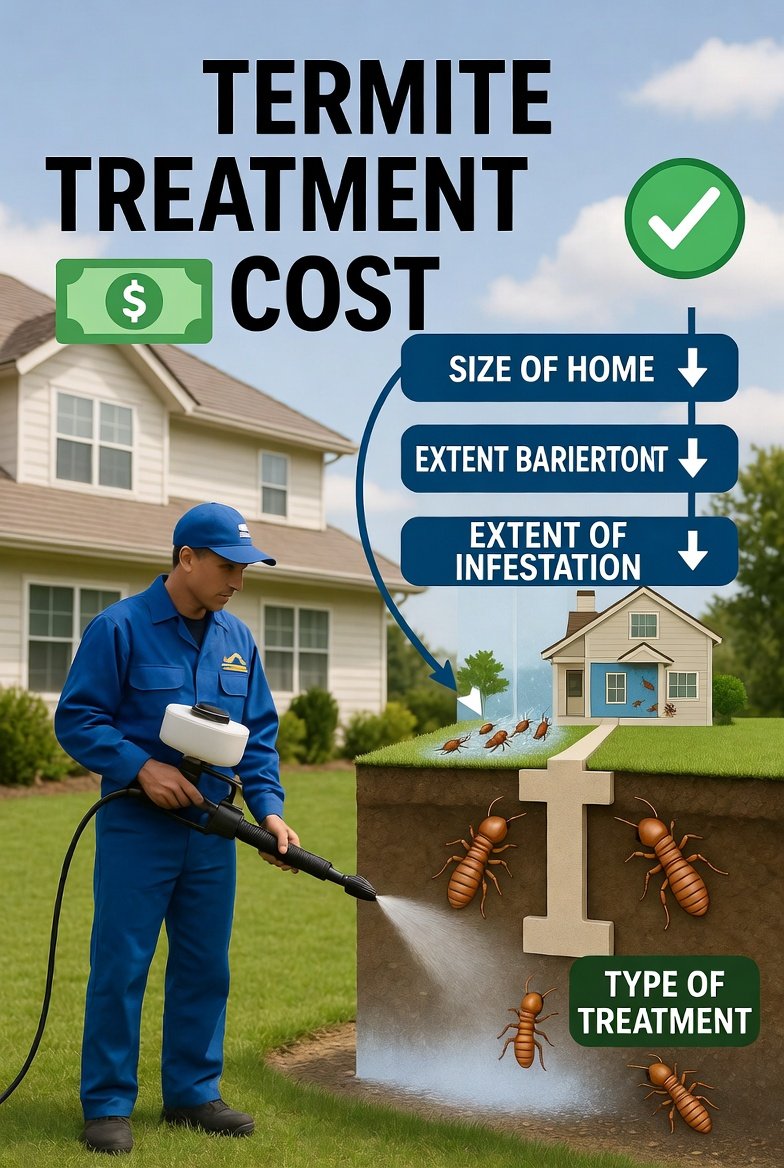
Termite treatment pricing is not based on square footage alone.
Instead, the cost reflects how much uncertainty the treatment removes.
Key factors affecting price include:
- termite species
• infestation spread
• treatment method required
• accessibility of affected areas
• construction type
• warranty or monitoring coverage
Two houses with the same floor plan may require completely different treatment strategies.
The Most Important Cost Driver: Treatment Method
Different treatment methods solve different risk problems.
Spot Treatment
Spot treatments target specific areas where termite activity has been identified.
Typical situations include:
- isolated infestations
• exposed wood framing
• early detection
Costs are usually lower but depend heavily on inspection accuracy.
If termites are present beyond the treated zone, additional treatment may be required later.
Liquid Soil Barrier Treatment
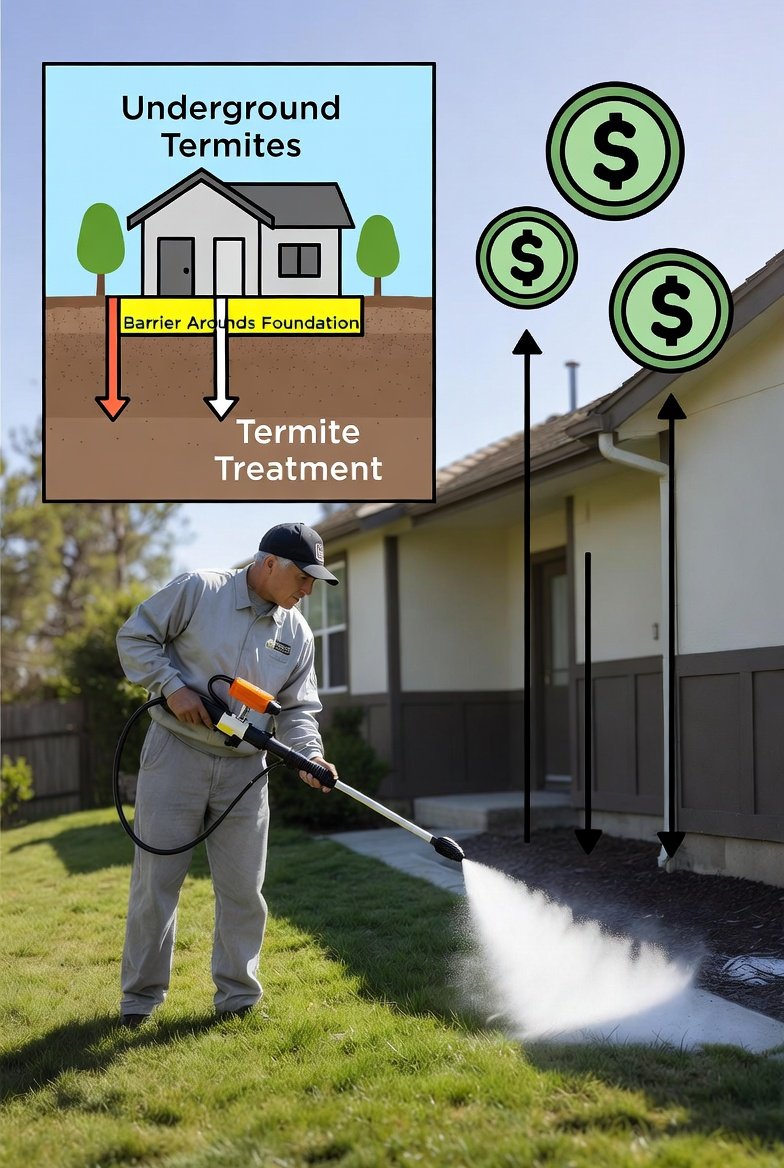
Liquid barrier treatments are commonly used for subterranean termites.
Technicians apply termiticide around the foundation to create a protective barrier that termites cannot cross.
This usually involves:
- trenching around the foundation
• injecting termiticide into soil
• sealing entry points
Pricing is typically calculated per linear foot of foundation.
Bait Station Systems
Bait systems eliminate termite colonies gradually.
Technicians install bait stations around the property perimeter.
Termites consume the bait and carry it back to the colony, disrupting growth.
Bait systems usually include:
- installation cost
• periodic monitoring visits
• annual service plans
Whole-Structure Fumigation (Tenting)
Fumigation is typically used for drywood termite infestations.
The home is sealed with a tent while fumigant gas penetrates wood framing.
Tenting is often recommended when:
- infestations appear in multiple locations
• termites are hidden inside walls
• localized treatment cannot guarantee elimination
Because fumigation treats the entire structure, it offers the highest level of certainty.
More detail here:
Subterranean vs Drywood Termite Treatment Costs
The termite species significantly affects treatment strategy.
Subterranean Termites
These termites live in soil and enter homes through foundations.
Common treatments include:
- liquid soil barriers
• trench-and-treat systems
• bait stations
These treatments target termite colonies living underground.
Drywood Termites
Drywood termites live inside wood structures rather than soil.
Treatment options include:
- localized wood treatment
• heat treatment
• whole-structure fumigation
Because drywood infestations are often concealed within framing, treatment costs may increase when access is limited.
Heat treatment pricing is explained here:
Factors That Affect Termite Treatment Cost
Several structural and environmental conditions influence the final price.
Infestation Size
Small localized infestations often require limited treatment.
Large infestations affecting multiple rooms may require full structural treatment.
Accessibility of Affected Areas
Termites hidden inside finished walls or sealed cavities require more complex treatment.
Limited access increases labor and equipment requirements.
Construction Type
Some construction designs complicate treatment.
Examples include:
- slab foundations
• finished basements
• complex foundation layouts
• sealed crawl spaces
Warranty and Monitoring Coverage
Many termite treatments include optional warranties.
Common options include:
- retreatment warranties
• monitoring plans
• termite protection bonds
Long-term monitoring plans can influence overall cost.
Prevention costs are discussed here:
termite-prevention-treatment-cost
Hidden Costs Homeowners Often Miss
Treatment quotes may not include all associated expenses.
Additional costs may include:
- temporary lodging during fumigation
• food storage and preparation requirements
• lost work time during treatment
• annual monitoring or renewal fees
• moisture repairs before treatment
These factors can significantly affect the real cost of termite control.
Real-World Treatment Cost Examples
Understanding real scenarios helps explain price variation.
Example 1 — Subterranean Termites
1,500 sq ft home with perimeter infestation.
Liquid barrier treatment recommended.
Typical cost: about $1,200 – $2,500 depending on foundation size.
Example 2 — Drywood Termites in Multiple Rooms
Inspection reveals activity across several interior walls.
Whole-structure fumigation required.
Typical cost: $3,000 – $6,000.
Example 3 — Small Localized Infestation
Termites found in exposed framing during renovation.
Spot treatment recommended.
Typical cost: $400 – $900.
When It May Be Reasonable to Wait
Immediate treatment is not always necessary.
It may be reasonable to delay treatment when:
- termite species has not been confirmed
• only a single sign of activity is present
• inaccessible areas prevent full evaluation
• follow-up inspection can clarify infestation extent
In these cases, improving access and scheduling another inspection may prevent unnecessary costs.
How to Evaluate Any Termite Treatment Quote
Instead of focusing only on price, ask these questions:
- What risk does this treatment remove?
• What areas are excluded?
• What happens if termites return?
• Does the plan include monitoring?
• What warranty coverage is included?
These answers provide far more insight than comparing quotes alone.
Bottom Line
Termite treatment cost depends primarily on species, infestation spread, and treatment method.
The right treatment is not necessarily the cheapest option.
It is the one that removes the actual termite risk present in your home.
Understanding how pricing works allows homeowners to evaluate treatment estimates intelligently and choose the solution that provides the right balance of cost and protection.