
Termite Treatment Pricing Breakdown by Method
Many homeowners compare termite treatment quotes assuming they are pricing the same service.
But termite treatment estimates are rarely comparable.
One exterminator may recommend a $1,200 liquid barrier treatment, another may suggest a $3,000 bait monitoring system, while a third contractor may quote $5,000 or more for whole-home fumigation.
These are not simply different prices for the same job.
They represent completely different treatment strategies.
Understanding termite treatment pricing by method helps homeowners compare exterminator quotes more realistically and avoid paying for treatments that may not match the infestation.
Quick Answer: Average Termite Treatment Cost by Method
Termite treatment costs vary widely depending on the method used to eliminate the infestation.
Treatment Method | Typical Price Range | Pricing Model | Monitoring Required |
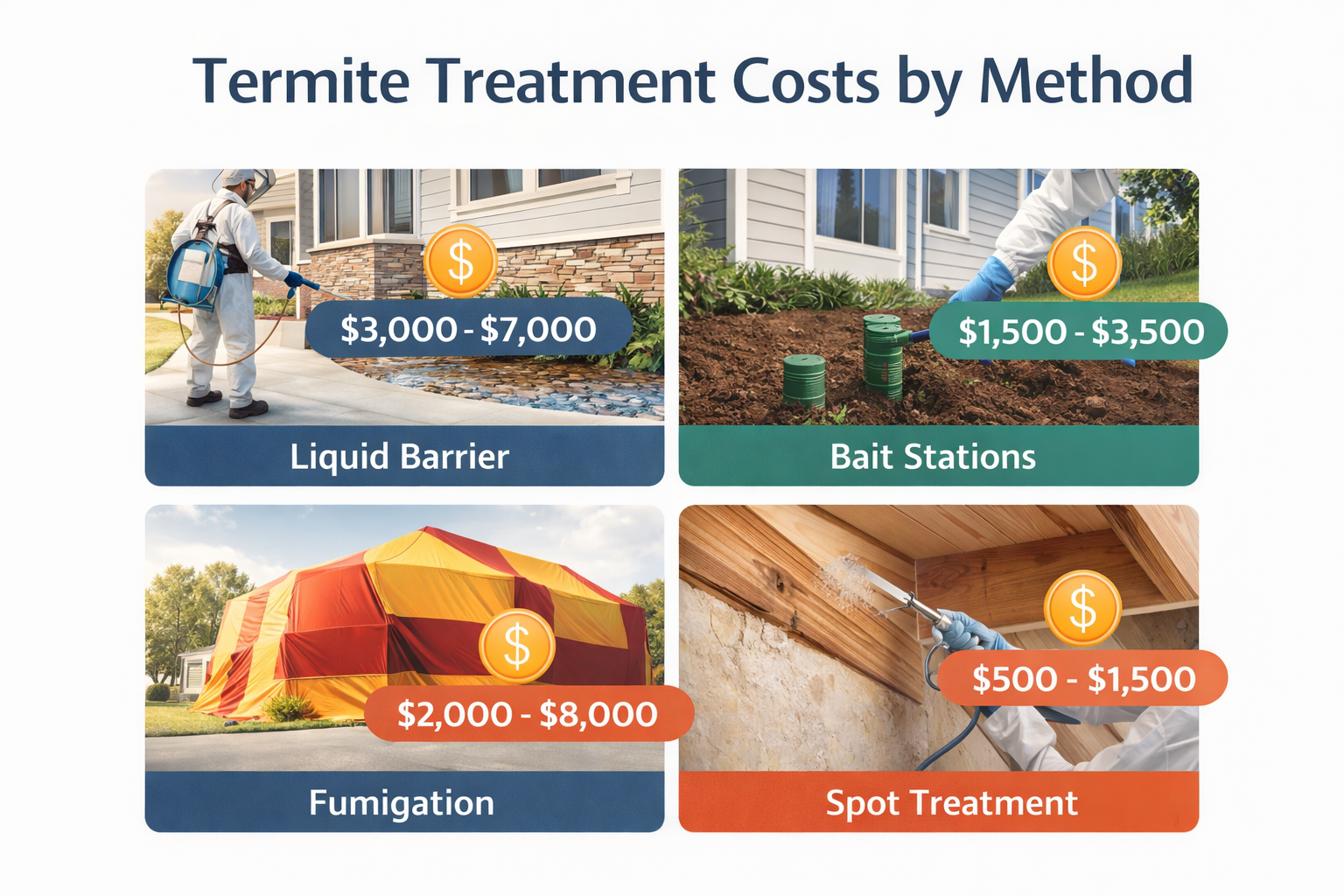
Liquid soil barrier treatment | $800 – $3,000 | Per linear foot of foundation | Rare |
Termite bait station system | $1,200 – $3,500 | Installation + monitoring | Yes |
Whole-structure fumigation | $2,000 – $8,000+ | Whole-home price | Rare |
Localized spot treatment | $300 – $1,200 | Per treatment area | Rare |
These ranges depend on infestation severity, home size, and treatment complexity.
A full overview of treatment pricing across infestations can be found in
termite-treatment-cost
Why Termite Treatment Prices Vary by Method
Termite treatments are priced differently because each method works in a different way.
Some approaches create chemical barriers that prevent termites from entering the structure, while others rely on bait systems that eliminate termite colonies gradually.
Because these systems involve different materials, labor requirements, and monitoring services, exterminator quotes can vary dramatically.
Common professional treatment methods include:
- liquid soil barrier treatments
• termite bait station systems
• whole-structure fumigation
• localized spot treatments
Each approach targets termites differently and therefore follows a different pricing model.
Liquid Soil Barrier Treatment
Liquid soil barrier treatments are the most common method used for subterranean termites.
Exterminators apply liquid termiticides into the soil surrounding the home’s foundation. This creates a treated barrier that termites must pass through before entering the structure.
The treatment either repels termites or transfers insecticide between colony members.
Typical Liquid Treatment Cost
Home Size | Typical Cost |
Small home | $800 – $1,500 |
Medium home | $1,200 – $2,500 |
Large home | $2,000 – $3,000+ |
Liquid treatments are typically priced per linear foot of foundation, which explains why larger homes cost more to treat.
Detection of subterranean termite activity usually occurs during inspections such as termite-structural-damage-inspection
Termite Bait Station Systems
Bait station systems work differently from liquid treatments.
Instead of creating a barrier, exterminators install bait stations in the soil surrounding the property. Termites consume the bait and carry it back to the colony, gradually eliminating it.
Bait systems are often used for long-term termite monitoring and prevention.
Typical Bait System Costs
Bait System Component | Typical Cost |
Initial installation | $1,200 – $3,500 |
Annual monitoring | $200 – $400 per year |
Because bait stations require ongoing inspections and bait replacement, they typically involve recurring monitoring costs.
Long-term prevention strategies are often discussed alongside treatment options such as
termite-prevention-cost
Whole-Structure Fumigation
Fumigation is typically used for drywood termite infestations that have spread throughout the structure.
During fumigation, the entire home is sealed under a tent and filled with fumigant gas that penetrates wood and eliminates termite colonies.
Because this process requires specialized equipment and temporary relocation of occupants, it is usually the most expensive treatment option.
Typical Fumigation Costs
Home Size | Typical Cost |
Small home | $2,000 – $4,000 |
Medium home | $3,500 – $6,000 |
Large home | $5,000 – $8,000+ |
Fumigation is generally recommended only when termites have spread throughout multiple structural areas.
Localized Spot Treatment
Spot treatments are used when termite activity is limited to a small area.
These treatments involve injecting insecticides directly into wood or applying localized chemical treatments to affected areas.
Typical Spot Treatment Costs
Infestation Size | Typical Cost |
Small localized infestation | $300 – $600 |
Moderate localized infestation | $600 – $1,200 |
Spot treatments are usually recommended when termites are detected early during inspections such as
termite-inspection-cost
One-Time Treatment vs Long-Term Monitoring
One important difference between termite treatment methods is the presence of ongoing monitoring costs.
Treatment Method | One-Time Cost | Recurring Cost |
Liquid soil barrier | Yes | Rare |
Bait station system | Yes | Annual monitoring |
Fumigation | Yes | Rare |
Spot treatment | Yes | Rare |
Bait systems often appear comparable in price to liquid treatments initially but may involve higher long-term costs due to monitoring services.
Example Termite Treatment Cost Scenario
Consider a typical homeowner situation.
A homeowner discovers mud tubes along the foundation and contacts a pest control company.
Step 1: Inspection
Inspection cost: $150
The inspector confirms subterranean termites.
Step 2: Treatment Recommendation
Liquid soil barrier treatment recommended.
Treatment cost: $1,600
Step 3: Preventive Monitoring
Annual inspection monitoring: $120
In this scenario, the total initial cost is about $1,750, followed by optional periodic inspections.
Inspection procedures used during real estate transactions are explained in
termite-inspection-for-home-purchase
Cheapest vs Most Expensive Termite Treatment Methods
Some termite treatment methods are significantly cheaper than others.
Treatment Method | Cost Category |
Spot treatment | Cheapest |
Liquid soil barrier | Moderate |
Bait monitoring systems | Moderate to high |
Whole-home fumigation | Most expensive |
However, the cheapest treatment is not always the best solution. Severe infestations often require more comprehensive treatment methods.
Choosing the Right Treatment Method
Professional termite inspections determine which treatment method is most appropriate.
Infestation Situation | Recommended Method |
Subterranean termites | Liquid barrier treatment |
Long-term monitoring needed | Bait station system |
Severe drywood infestation | Fumigation |
Early localized infestation | Spot treatment |
If termites have already caused structural damage, repairs may also be necessary. Repair costs are explained in
termite-damage-repair-cost
What This Means for Homeowners
Termite treatment costs vary widely because exterminators use different methods to eliminate infestations.
Liquid barrier treatments, bait station systems, fumigation, and localized treatments all involve different pricing models and long-term maintenance requirements.
Understanding which treatment method is being proposed allows homeowners to compare exterminator quotes more realistically and choose the option that best fits the infestation.
FAQs
What is the average cost of termite treatment?
Most termite treatments cost between $800 and $3,000 depending on the treatment method and infestation severity.
Why do exterminator quotes vary so much?
Different companies may recommend different treatment methods such as liquid barriers, bait systems, or fumigation, which follow different pricing models.
Is bait treatment cheaper than liquid treatment?
Bait systems may have similar installation costs but often involve ongoing monitoring fees that increase long-term cost.
When is fumigation necessary?
Fumigation is usually recommended for severe drywood termite infestations affecting large portions of the structure.
Can termite infestations return after treatment?
Yes. New termite colonies may enter the property if preventive monitoring or inspections are not maintained.