
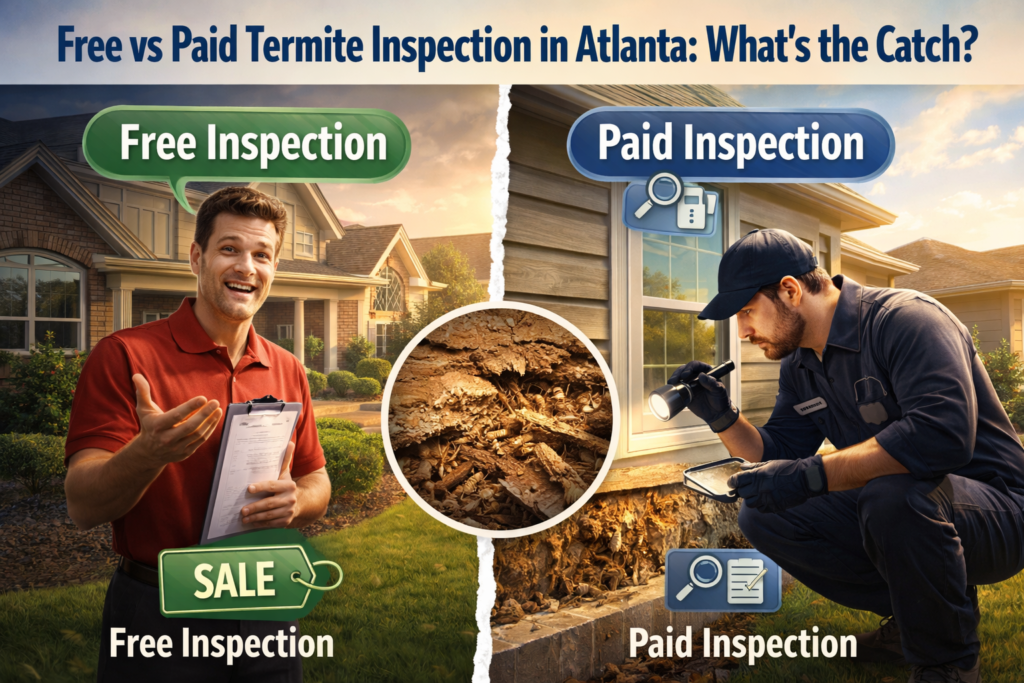
It Usually Starts Small—Then You’re Not Sure What You’re Looking At
After a humid Atlanta rain, you notice something odd. A few winged insects near a window. Maybe a thin line of dirt along the crawl space wall.
Nothing dramatic. But not something you can ignore either.
You search online and see the same promise everywhere:
👉 “Free termite inspection in Atlanta”
Sounds easy—but this is where things get unclear:
- Is a free inspection enough?
- Are they diagnosing or selling?
- Do you actually need a detailed inspection?
In Atlanta, termite problems often stay hidden until the damage is expensive enough to force action.
Quick Answer: Do You Need a Termite Inspection in Atlanta?
If you’ve seen mud tubes, wings, soft wood—or you’re buying a home—you should schedule an inspection immediately. In Atlanta’s humid, crawl-space-heavy housing environment, termite activity often starts long before visible damage.
Why Atlanta Homes Are More Likely to Have Hidden Termite Issues
Atlanta doesn’t just have termites—it has conditions that help them stay unnoticed.
Local risk factors that matter:
- Eastern subterranean termites dominate (they attack from soil upward)
- High humidity + frequent rain → constant moisture
- Crawl space homes → hidden structural access
- Tree cover + shaded lots → soil stays damp longer
- Mulch and landscaping near foundations → concealed entry zones
👉 In many Atlanta homes, termites don’t need to “invade”—they’re already close.
What Free vs Paid Termite Inspections Really Mean in Atlanta
This is where most homeowners get misled.
Inspection Type | Typical Price | Best For | Limitation |
Free inspection | $0 | quick initial check | often tied to treatment sales |
Basic paid inspection | $75–$150 | independent opinion | may not include report |
WDO / real estate inspection | $100–$250 | home purchase | focused on documentation |
Detailed inspection | $200–$600 | complex or hidden cases | higher upfront cost |
How to interpret this:
- Free inspections are designed to identify obvious issues and move toward treatment
- Paid inspections are more neutral and diagnostic
- WDO reports are required for transactions—but not always deeper analysis
👉 You’re not just choosing a price—you’re choosing how thorough and unbiased the inspection will be.
For general inspection pricing context:
termite-inspection-cost
Real Atlanta Scenario (What Actually Happens)
A homeowner in East Atlanta noticed winged insects near a window after a storm.
They assumed they were ants.
Weeks later:
- Crawl space inspection revealed mud tubes near support beams
- Moisture buildup had been present for months
- Termites had already started structural feeding
Outcome:
- Initial inspection: free
- Follow-up detailed inspection: $175
- Treatment: $1,200
- Preventive adjustments required
👉 The delay didn’t create the problem—but it made it more expensive.
How Termite Inspections Work in Atlanta Homes
Atlanta homes vary—and inspection approach changes with them.
Home Type | What Inspectors Focus On | Why It Matters |
Crawl space homes | beams, subfloor, moisture | highest risk zone |
Slab homes | foundation edges, cracks | hidden entry points |
Older homes | exposed wood, aging structure | higher vulnerability |
Newer homes | early risk indicators | prevention stage |
👉 Crawl spaces are critical—many infestations begin where homeowners rarely look.
What Inspectors Prioritize First in Atlanta Homes
Instead of just listing signs, here’s how inspectors actually think:
1. Moisture-heavy zones
- Crawl spaces, plumbing areas, drainage points
👉 Termites follow moisture patterns
2. Structural access points
- Foundation gaps, expansion joints, siding contact
👉 These are entry routes, not just weak spots
3. Wood exposure conditions
- Decks, support beams, untreated wood
👉 Direct feeding opportunities
4. Previous treatment evidence
- Old bait systems, partial barriers
👉 Can indicate incomplete protection
Do You Actually Need an Inspection Right Now?
Situation | Risk Level | What To Do |
Mud tubes visible | High | Immediate inspection |
Wings indoors | Medium–High | Inspect soon |
Soft or hollow wood | High | Immediate |
Buying a home | High | Required |
No signs, but crawl space moisture | Medium | Preventive inspection |
If you’re unsure whether damage is structural:
termite-structural-damage-inspection
Why Termite Inspections Often Turn Into Treatment Quotes
This part confuses a lot of homeowners.
Here’s what’s happening:
- Many companies inspect with treatment in mind
- Visible signs often trigger immediate recommendations
- Some quotes are based on risk—not confirmed activity
👉 A treatment recommendation isn’t always wrong—but it should be clearly explained.
Why Some Termite Inspections Miss Problems
Even good inspections have limits.
Common reasons:
- Crawl spaces blocked by insulation or storage
- Finished areas hiding structural elements
- Hidden infestations inside walls
- Rushed free inspections focused only on visible areas
👉 A clean inspection doesn’t always mean no termites—it means nothing obvious was found.
Inspection Results — What They Actually Mean
Result | Meaning | Next Step |
No activity | Low immediate risk | Prevention |
Old damage | Past infestation | Monitor |
Active termites | Current issue | Treatment |
Structural damage | Advanced stage | Repair |
If treatment is needed:
termite-treatment-cost
If repairs are needed:
termite-damage-repair-cost
Atlanta Home Conditions vs Inspection Priority
Condition | Why It Raises Risk | Priority |
Damp crawl space | moisture + hidden access | High |
Older wood-framed home | exposed structure | High |
Landscaping against foundation | concealed entry | Medium–High |
No previous termite report | unknown history | High |
What Happens After the Inspection (The Full System)
Stage | What Happens |
Detection | Inspection identifies issue |
Active infestation | Treatment applied |
Damage present | Repairs performed |
Future protection | Prevention plan |
For prevention strategies:
termite-prevention-cost
For advanced cleanup:
Common Atlanta-Specific Mistakes
1. Assuming Crawl Space Moisture Is “Normal”
It often signals termite-friendly conditions.
2. Letting Landscaping Stay Tight to the Structure
Mulch and soil can hide entry points.
3. Relying Only on a Quick Free Inspection
May miss deeper structural risks.
4. Waiting for Visible Damage
Damage is usually advanced by then.
Decision Framework: What Should You Do Next?
- Signs present → inspect immediately
- Buying home → request WDO inspection
- Crawl space moisture → preventive inspection
- Got a quote → compare scope, not just price
If you’re in Atlanta and something already looks off, the cheaper move is usually the inspection—not waiting to find out what the damage costs later.
FAQs
Do termite inspections in Atlanta include crawl spaces?
Yes—especially for homes where crawl spaces are accessible. This is often the highest-risk area.
Is a termite inspection different from a home inspection in Georgia?
Yes. A termite (WDO) inspection focuses specifically on wood-destroying organisms, not general home condition.
Can a free termite inspection miss damage?
Yes. Free inspections often focus on visible signs and may not detect hidden infestations.
How often should termite inspections be done in Atlanta?
Every 1–2 years due to humidity and termite activity.