
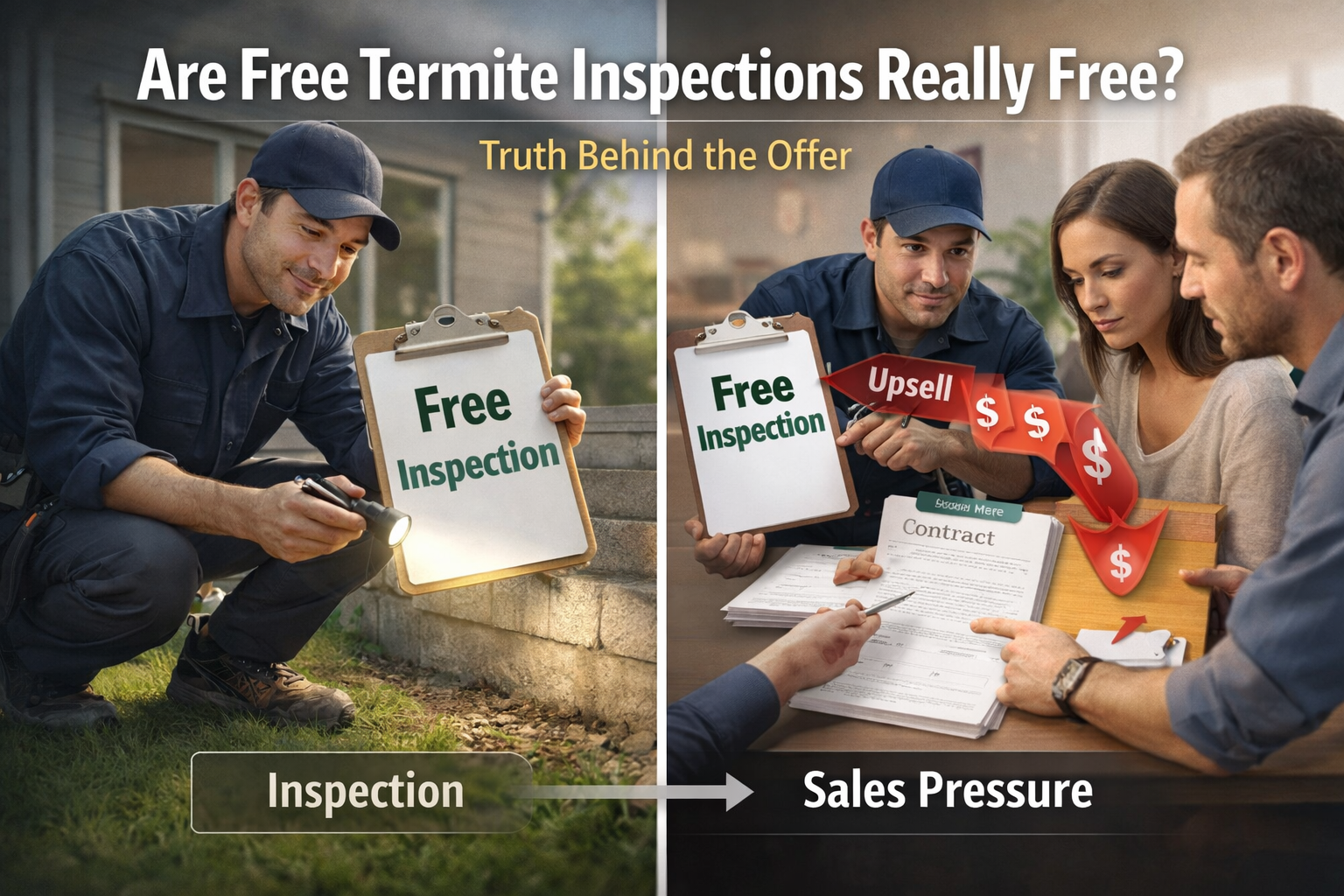
Free Termite Inspection (Are They Really Free?)
A homeowner gets a postcard in the mail advertising a free termite inspection.
At first glance, it sounds like an easy yes. Termites can cause serious structural damage, and having a professional check the house without charging anything seems like a smart move.
Then the doubt kicks in.
Is it actually free?
Is there a hidden fee later?
Will the inspector find “something serious” and push an expensive treatment the same day?
That hesitation is reasonable. A free termite inspection is often a real service, but it is also often the first step in a sales process. That does not automatically make it dishonest. It just means homeowners need to understand what is being offered, what the inspection can realistically tell them, and what happens after the technician leaves.
That is the real question behind this keyword.
Not whether “free” is always fake.
But whether the inspection is useful, limited, and tied to a business motive at the same time.
For most homeowners, the right answer is simple: a free termite inspection can be worthwhile, but only if you know what it is — and what it is not.
What Is a Free Termite Inspection?
A free termite inspection is usually a basic visual inspection of accessible areas of a property performed by a pest control technician or termite specialist.
The purpose is to look for:
- visible termite activity
- visible termite damage
- conditions that make termite activity more likely
In most cases, the technician checks areas such as:
- the foundation perimeter
- crawlspaces or basements
- attic framing where accessible
- exposed wood
- garage walls and slab edges
- door and window frames
- plumbing entry points
- areas with moisture or wood-to-soil contact
This kind of inspection is usually designed to answer a practical first-level question:
Do visible signs suggest termites, past termite damage, or elevated termite risk?
For homeowners who just want a first screening, that can be useful. For homeowners who need formal documentation, it may not be enough.
Are Free Termite Inspections Really Free?
Usually, the inspection visit itself is free.
That means:
- no charge for the technician to come out
- no charge for a basic visual evaluation
- no upfront fee just to look at the property
But that does not mean the whole process is free.
The inspection is often free because the company hopes one of three things happens:
- the technician finds active termites
- the technician finds conditions conducive to termites
- the technician earns enough trust to sell prevention or monitoring services
So the right way to think about the offer is this:
The inspection may be free to the homeowner, but it is not free from a business perspective.
The company is spending time and labor because the inspection can lead to paid work later.
That is the part many homeowners sense instinctively. And they are not wrong.
Why Pest Control Companies Offer Free Inspections
Free termite inspections are usually part of a lead-generation model.
Termite treatment, fumigation, repair-related services, and ongoing monitoring can all be valuable jobs for a pest control company. Offering a free inspection gets the technician in front of the homeowner and gives the company a chance to identify problems.
From the company’s side, the logic is simple:
- a homeowner worried enough to book an inspection may also buy treatment
- termite problems are often discovered only after someone looks carefully
- early contact helps the company build trust and increase conversion later
From the homeowner’s side, the service can still have value.
A company can have a commercial motive and still perform a useful inspection.
The problem is not the business model itself. The problem starts when homeowners mistake a free inspection for a full independent evaluation, or when a company uses fear and urgency to push treatment before the homeowner understands the findings.
That is why pages like termite-treatment-cost matter in this cluster. Once a company finds something, the next question is almost always about the size of the bill.
How a Free Termite Inspection Usually Works
Most free termite inspections are pretty straightforward.
A technician comes out, walks the property, checks visible risk zones, and then explains what was found. In many cases, the inspection takes 30 to 60 minutes, depending on the size of the house and how accessible the inspection areas are.
A typical process looks like this:
Inspection Step | What the Technician Usually Checks |
Exterior walkaround | mud tubes, foundation edges, wood-to-soil contact, moisture spots |
Crawlspace or basement | structural wood, damp conditions, damaged framing |
Interior review | visible wood damage, soft spots, paint blistering, suspicious trim |
Attic or upper framing | exposed beams, drywood activity signs where access exists |
Findings discussion | evidence found, risk conditions, next-step recommendations |
The best inspections feel calm and methodical.
The weaker ones feel rushed and sales-driven.
A homeowner should leave the appointment understanding:
- whether visible evidence was found
- where it was found
- whether the problem appears active, old, or uncertain
- what the recommended next step is
If that clarity is missing, the inspection may not have much practical value.
What Inspectors Actually Look For
A good termite inspector is not just looking for live termites.
They are looking for evidence patterns.
Typical signs include:
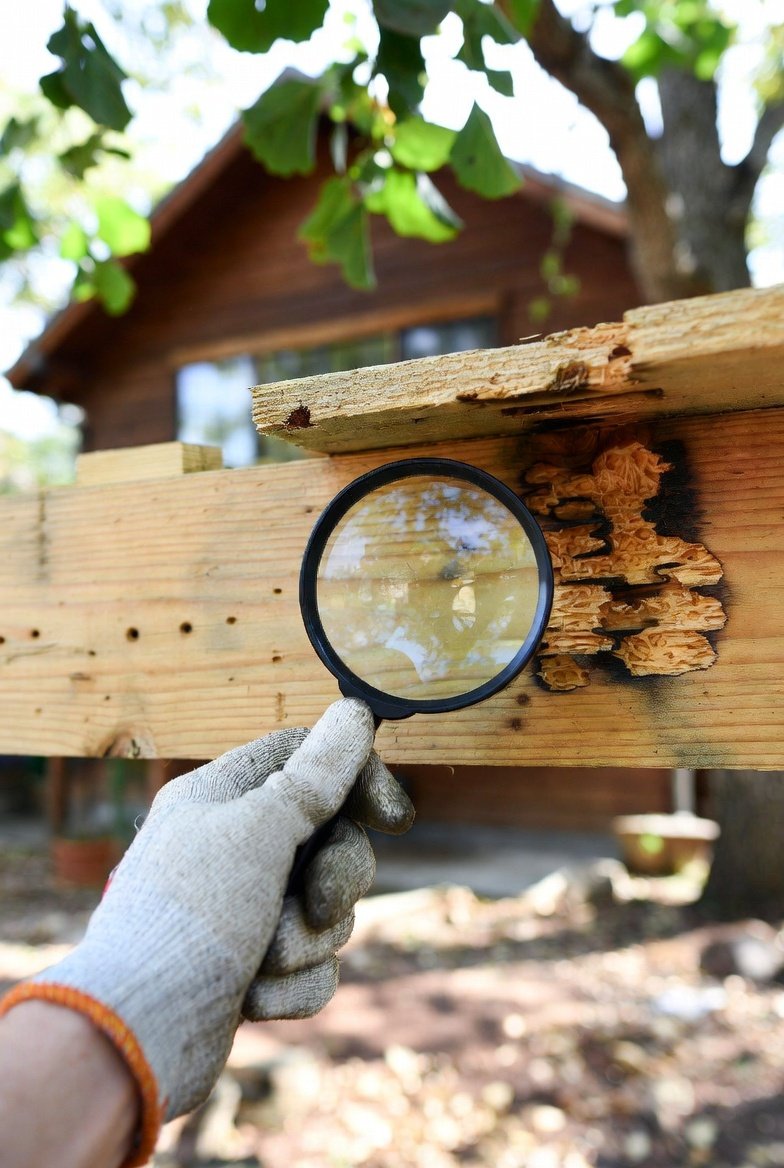
- mud tubes on foundations or walls
- damaged or hollow wood
- blistering or distorted painted surfaces
- discarded wings near windows or doors
- termite droppings or frass
- moisture-heavy zones near structural wood
- wood debris, poor drainage, or vegetation creating risk conditions
That is one reason free inspections can still help even when no active termites are found. A technician may still identify conditions that increase the chance of an infestation later.
If those conditions are present, the homeowner may not need treatment right away, but may need prevention work, moisture correction, or future monitoring. That links naturally to
termite-prevention-cost because prevention questions often come before treatment questions.
What “Free” Usually Means — and What It Does Not Mean
This is the section most homeowners actually need.
A free termite inspection usually means:
- the company will inspect at no upfront charge
- the visit is meant to detect obvious or visible signs
- the homeowner gets a basic verbal explanation or informal summary
It usually does not mean:
- a formal written report is included
- the company is acting as a neutral third party
- hidden termite damage has been ruled out
- any treatment or follow-up work will be free
That distinction matters a lot.
A homeowner may hear “free inspection” and assume it covers everything needed to make a major decision. In reality, a free inspection is often best viewed as a screening visit, not a full decision-grade report.
When Termite Inspections Are Not Free
There are several situations where termite inspections are commonly paid services.
These include:
- home purchases
- lender-required documentation
- official wood-destroying insect reports
- legal or insurance disputes
- second-opinion inspections from independent firms
- situations where the homeowner wants formal written documentation
That is why it helps to separate free screening from formal reporting.
Inspection Type | Typical Use | Typical Cost |
Free inspection | basic homeowner screening | Free |
Paid inspection | formal report or transaction documentation | Usually paid |
Paid second opinion | verification of findings or treatment quote | Usually paid |
If you want the broader pricing context, the cluster’s
termite-inspection-cost page covers the fee side in more detail.
Free Inspection vs Paid Inspection: Which One Do You Actually Need?
The answer depends on the situation.
A free inspection usually makes sense when:
- you noticed something suspicious
- your house has not been checked in years
- you live in a termite-prone area
- you want a low-friction first screening
- you are comfortable getting a second opinion if needed
A paid inspection is usually better when:
- you are buying or selling a home
- a lender needs documentation
- there is a repair dispute
- you need an official written report
- you want a more independent evaluation before spending thousands on treatment
Here is the decision framework in a simple format:
Situation | Free Inspection a Good First Step? | Better Choice |
You saw mud tubes or wings | Yes | Start with free screening, then verify if needed |
You want general peace of mind | Yes | Free screening can be enough |
You are under contract on a house | Not enough on its own | Paid formal inspection |
You got a large treatment quote already | Sometimes | Paid second opinion often smarter |
You need closing or lender paperwork | No | Paid formal report |
This section is one of the biggest ranking advantages for the page, because most service pages never explain the decision this clearly.
Important Limitation: What Free Inspections Cannot Detect
This is one of the most important trust sections in the article.
Most termite inspections — especially free ones — are visual inspections of accessible areas.
That means inspectors usually do not:
- open finished walls
- remove flooring
- cut into ceilings
- dismantle cabinets
- uncover hidden framing inside sealed structures
So yes, termites can be missed.
Not because every inspector is careless, but because some damage or activity is concealed. Hidden wall cavities, blocked crawlspaces, heavy storage, finished basements, and inaccessible framing can all limit what the inspector can actually evaluate.
That is why a clean free inspection should be interpreted as:
No visible evidence was found in the accessible areas checked.
It should not be interpreted as:
The home is guaranteed termite-free.
That limitation becomes even more important when repair costs enter the picture, because hidden structural damage may only become obvious later. If visible damage already exists, the next practical question may shift toward
termite-damage-repair-cost, not just inspection findings.
Red Flags to Watch for During a Free Inspection
Most companies are not running scams. But some inspections are handled in ways that should make a homeowner slow down.
Watch for red flags like these:
- the inspector claims “severe infestation” but shows no evidence
- treatment is pushed immediately with same-day urgency
- the most expensive option is recommended first without explaining alternatives
- the company refuses to show the area where termite activity was found
- the verbal explanation is vague, but the quote is very specific
- the “free” inspection suddenly turns into a paid report without clear disclosure
- the company discourages second opinions
A trustworthy inspection should allow the homeowner to ask:
- Where exactly did you see evidence?
- Can you show me photos or the actual location?
- Is this active termites, old damage, or just conducive conditions?
- What are my treatment options?
- Do I need immediate action, or do I need more verification first?
If a company gets uncomfortable with those questions, that tells you something.
What Homeowners Should Ask Before Booking
A homeowner can avoid a lot of confusion by asking a few questions before the inspection is scheduled.
Ask:
- Is the inspection visit completely free?
- Is there any charge for a written report?
- Will I receive photos or documentation if evidence is found?
- What happens after the inspection?
- Are treatment quotes provided the same day?
- Do you charge for a second visit or a more formal report?
These are simple questions, but they clarify whether the company is offering a basic screening visit or something more formal.
What Happens If Termites Are Found
If visible termite activity is found, the company will usually recommend treatment.
Depending on the property and the infestation type, that may include:
- liquid soil treatment
- bait stations
- localized wood treatment
- spot treatment
- full fumigation in more severe or specific cases
That is where cost anxiety usually starts.
A homeowner who came in thinking only about a free inspection may suddenly be staring at a large proposal. That is why internal cluster pages like termite-fumigation-cost and termite-treatment-cost are so important. The inspection is rarely the end of the decision. It is usually the beginning.
If the quote feels aggressive, unclear, or too expensive, a second opinion is a reasonable move.
When a Free Inspection Is Actually a Smart Move
Despite the skepticism around the keyword, free inspections can make sense.
They are often worth considering when:
- you noticed possible termite signs
- the house has not been checked in a long time
- you live in an area where termite activity is common
- you want a quick initial screening without committing to a paid report
- you are willing to verify large findings before approving major treatment
The key is using the inspection as information, not as automatic proof that the first sales proposal is the only answer.
Bottom Line
Yes, free termite inspections are usually really free in the narrow sense that the company does not charge for the visit itself.
But they are also usually sales entry points.
That is the honest answer.
The inspection can still be useful. It can identify visible termite activity, show risk conditions, and give a homeowner an early warning before damage gets worse. But it should be understood as a screening tool tied to a business motive, not as a full independent guarantee.
For most homeowners, the smartest approach is this:
Use the free inspection for what it is.
Ask questions.
Look at the evidence.
Slow down if the quote feels rushed.
And when the stakes are high, pay for a more formal inspection or a second opinion.
That is how a free termite inspection becomes useful instead of stressful.
FAQs
Are free termite inspections really free?
Usually, yes. The company often does not charge for the inspection visit itself, but the inspection is typically meant to generate treatment opportunities if termite activity or risk conditions are found.
Is a free termite inspection a scam?
Not usually. Most are legitimate screening services. The bigger issue is not whether they are fake, but whether the homeowner understands that the inspection may lead to a sales pitch for treatment.
Do pest control companies charge for termite inspections?
Many companies offer basic homeowner inspections for free. Formal reports, real-estate inspections, lender-required documentation, and second opinions are often paid services.
How much does a termite inspection cost if it is not free?
Paid inspections vary by situation, but formal inspections and written reports usually cost more than a basic free screening visit.
Do free termite inspections include a written report?
Not always. Some companies provide only a verbal explanation unless the homeowner pays for a more formal report or transaction-grade documentation.
Should I get a second opinion before paying for treatment?
It can be a smart move, especially if the treatment quote is large, the evidence is unclear, or the company is applying strong same-day pressure.
Is a termite inspection required when buying a house?
A free inspection is usually not enough for a real-estate transaction. Buyers often need a more formal inspection or report, which is why
termite-inspection-for-home-purchase
is a separate issue.