
Termite Treatment in Houston: Why the Visible Problem Is Usually the Smaller One
In Houston, termite treatment rarely starts at the real source of the problem.
Most homeowners act when they notice something visible—soft wood, minor damage, or signs near baseboards. But by then, the infestation is often already established underground, spreading through soil and foundation gaps long before it reaches visible surfaces.
That’s where most decisions go wrong.
👉 The visible damage is not the full problem—it’s just the part you can see.
Quick Answer
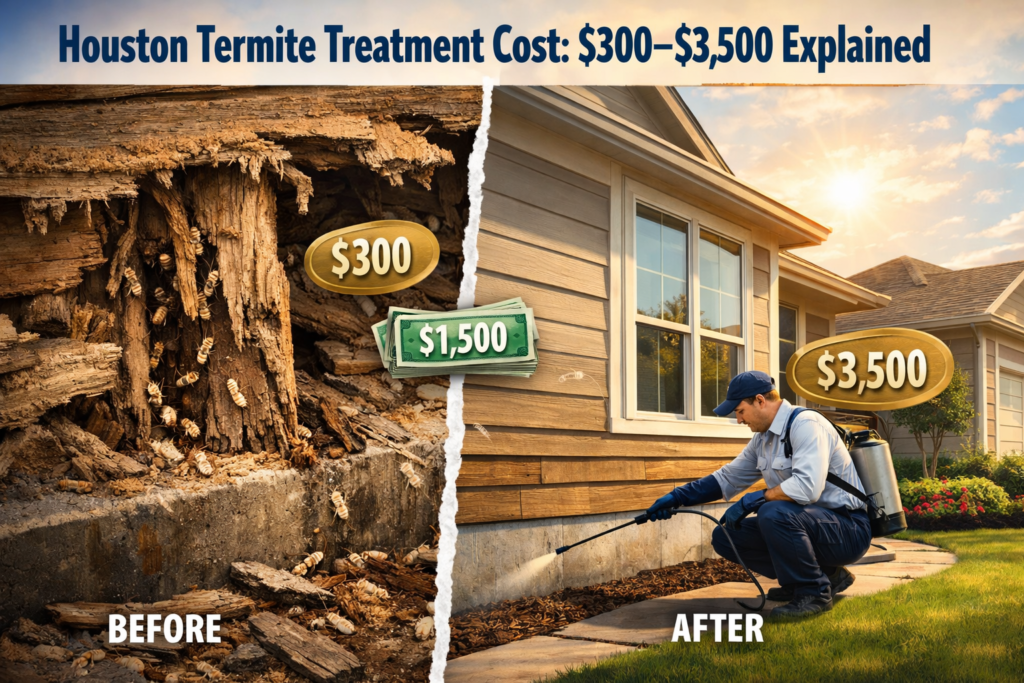
Termite treatment in Houston typically costs $300 to $3,500+, depending on the method and severity. Most infestations involve subterranean termites, which means treatment usually targets the soil around the foundation, not just the interior of the home.
Why Termite Treatment in Houston Is Ground-Focused (Not Surface-Focused)
Houston’s environment changes how termite problems develop—and how they must be treated.
Key Environmental Drivers
- warm climate year-round
- high humidity
- moisture-retaining soil
- irrigation and drainage patterns around homes
What This Means for Treatment
Condition | Real Impact on Treatment |
Moist soil | Sustains large underground colonies |
Slab foundations | Hidden entry points at perimeter |
Irrigation systems | Keeps soil damp near structure |
Poor drainage | Increases reinfestation risk |
👉 In Houston, effective treatment starts below the home, not inside it
How Termite Treatment Actually Works (What Most People Miss)
Termite treatment is not about killing visible insects.
👉 It’s about interrupting the colony system beneath your home
Real Treatment Flow
- confirm infestation through inspection
- identify entry pathways
- target colony through soil or bait systems
- prevent re-entry
This is why inspection always comes first, as explained in
termite-inspection-cost
How to Tell Which Termite Treatment You Actually Need
Two homes in Houston can have termites—but require completely different treatment strategies.
Decision Framework (Houston-Specific)
Situation | What It Means | Recommended Direction |
Activity near foundation | Soil-based entry | Liquid barrier |
Small localized damage | Limited spread | Spot treatment |
No clear entry but risk present | Colony nearby | Bait system |
Widespread activity | Advanced infestation | Combined approach |
👉 The correct treatment depends on how termites entered—not just where damage appears
Main Termite Treatment Methods in Houston (With Real-World Fit)
Liquid Barrier Treatment (Most Common)
- applied to soil around foundation
- creates a protective treatment zone
Best fit:
Active subterranean infestation near slab or foundation
Weak fit:
Incomplete perimeter applications
Bait System
- installed around property
- targets colony gradually
Best fit:
Long-term monitoring and control
Weak fit:
Situations needing immediate results
Spot Treatment
- applied to specific areas
Best fit:
Small, well-contained infestations
Weak fit:
Hidden or spreading termite activity
Fumigation (Rare in Houston)
- used for drywood termites
Best fit:
Severe non-subterranean cases
Weak fit:
Most Houston homes
👉 Subterranean termites dominate Houston, which is why soil-based treatments are the standard

Cost of Termite Treatment in Houston
Typical Price Ranges
Treatment Type | Cost |
Spot treatment | $300 – $1200 |
Liquid barrier | $800 – $3000 |
Bait system | $1200 – $3500 |
Fumigation | $2000 – $8000+ |
For a deeper cost breakdown, see
termite-treatment-cost
Why One Houston Treatment Quote May Be Very Different From Another
This is where many homeowners make costly mistakes.
Two quotes may appear similar—but include very different levels of protection.
What Actually Changes the Price
- full perimeter vs partial treatment
- accessibility of the home’s foundation
- infestation severity
- inclusion of follow-up visits
- whether moisture conditions are addressed
Quote Comparison Table
Feature | Better Value | Warning Sign |
Coverage | Full perimeter | Partial or unclear |
Follow-up | Included | Additional cost |
Method match | Specific to infestation | Generic recommendation |
Moisture control | Addressed | Ignored |
👉 The cheapest option often leads to higher long-term cost
How to Choose the Right Termite Treatment Company in Houston
Not all termite services deliver the same level of protection.
What a Good Treatment Plan Should Include
- full perimeter soil treatment
- clearly defined treatment method
- follow-up monitoring or inspection
- written warranty (typically 1–5 years)
Red Flags to Watch For
- unusually low upfront pricing
- unclear or vague treatment scope
- no mention of follow-up
- no warranty coverage
Reality in Houston
Some companies offer low initial pricing but:
- limit treatment coverage
- charge additional renewal fees
- or fail to address underlying moisture issues
👉 The goal is not just treatment—but long-term control
How Termite Treatment Works in Houston (What Most Homeowners Don’t See)
In Houston, treatment is often structured differently than expected.
Common Industry Patterns
- free inspections tied to treatment recommendations
- annual service agreements or renewals
- pricing based on scope, not just size
Why This Matters
Two companies may recommend different treatments based on:
- how they assess risk
- how they structure long-term protection
- whether they prioritize monitoring or immediate control
👉 Understanding this helps you evaluate what you’re actually paying for
Real Scenario: A Typical Houston Treatment Case
A homeowner notices minor baseboard damage.
Inspection reveals:
- mud tubes along foundation edge
- active subterranean termites
- moisture accumulation near slab
Treatment Plan
- full liquid barrier around foundation
- localized interior treatment
- drainage adjustments recommended
👉 Without addressing soil and moisture, the infestation would likely return.
Why Termite Treatment Fails in Houston
Most treatment failures are not immediate—they happen over time.
Common Failure Points
- choosing the cheapest quote without full coverage
- incomplete soil barrier
- ignoring moisture and drainage issues
- no follow-up or monitoring
- treating visible damage instead of the source
👉 Effective treatment addresses both the infestation and the conditions behind it
Treatment vs Prevention
Action | Purpose |
Treatment | Eliminate active termites |
Prevention | Reduce future infestation risk |
More on prevention here:
termite-prevention-cost
Treatment vs Repair
Treatment stops termite activity.
Repair addresses structural damage.
See repair costs explained in
termite-damage-repair-cost
👉 Many homes require both depending on infestation duration.
How to Decide Without Guessing
- activity near foundation → barrier treatment likely needed
- unclear infestation source → deeper inspection required
- large price differences → compare coverage, not just cost
- treatment ignores moisture → long-term risk remains
👉 The right decision is based on cause—not just price
How Treatment Fits Into the Bigger System
Termite control is a sequence—not a single step.
The Full Process
- inspection
- treatment
- prevention
- repair
For full remediation context:
termite-remediation-cost
Final Takeaway
In Houston, termite treatment is not about fixing what you can see.
It’s about stopping what’s happening underneath.
Most infestations begin in the soil, move through foundation gaps, and only become visible later.
The right treatment works because it:
- targets the colony
- blocks entry points
- addresses moisture and environmental conditions
Getting this right the first time is what prevents the problem from coming back.
FAQs
How much does termite treatment cost in Houston?
Most treatments range from $300 to $3500 depending on the method and severity.
What is the most effective termite treatment in Houston?
Liquid barrier treatment is typically the most effective for subterranean termites.
Do Houston homes usually need soil treatment?
Yes, because termites commonly enter from the ground.
Is fumigation common in Houston?
No, fumigation is rarely used due to the dominance of subterranean termites.
Can termites come back after treatment in Houston?
Yes, especially if soil conditions and entry points are not properly managed.